
The global push toward decarbonization has intensified the need for transitional fuels capable of reducing emissions without requiring a complete transformation of existing energy infrastructure. Ethyl Tert-Butyl Ether (ETBE) has rapidly emerged as one of the most practical and effective solutions in this landscape. Positioned between traditional fossil-derived gasoline and fully renewable alternatives, ETBE enables fuel producers and policymakers to close the gap between present-day combustion engines and future sustainable mobility goals.
ETBE’s Strategic Role in Fuel Transition
ETBE is manufactured by reacting bioethanol with isobutylene, creating a highly stable oxygenated compound that integrates seamlessly into modern gasoline blends. Its appeal lies in its ability to enhance fuel performance while simultaneously contributing renewable content. Because it behaves similarly to conventional ethers used in gasoline, ETBE offers a path to carbon reduction without forcing industries to redesign transportation infrastructure or fuel distribution systems.
Its combustion properties bring meaningful improvements in air quality. Higher oxygen content supports cleaner burning, which helps reduce engine deposits, particulate emissions, and carbon monoxide formation. In regions dealing with urban pollution or adhering to strict environmental directives, these performance advantages make ETBE not only relevant but essential.
Global Market Momentum Behind ETBE
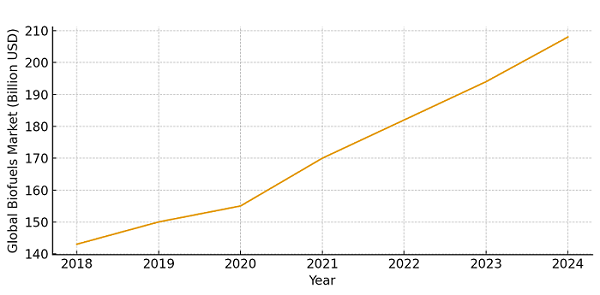
The expanding demand for renewable fuel components is evident in the steady growth of the global biofuels market. From 2018 to 2024, the sector moved from USD 143 billion to more than USD 208 billion, driven by tightening emissions mandates, government incentives, and renewed investment in sustainable energy technologies. ETBE benefits directly from this upward trend, as its use is closely tied to ethanol production, renewable fuel quotas, and evolving gasoline specifications.
The chart you see below illustrates this market trajectory, highlighting the growing economic foundation that supports ETBE adoption. As nations enforce higher blending obligations and automotive sectors advance toward cleaner engine designs, ETBE’s relevance becomes stronger year after year.
Global Biofuels Market Growth 2018–2024
A High-Performance Octane Enhancer with Clear Advantages
One of the most compelling reasons for ETBE’s rising popularity is its ability to improve octane quality efficiently and reliably. High-octane fuels support better combustion and higher engine efficiency – both of which are essential as vehicle manufacturers design engines optimized for lower emissions and improved mileage. ETBE enhances gasoline stability and offers excellent resistance to oxidation, ensuring that fuels retain their quality during storage and transportation.
Unlike ethanol, which can introduce volatility challenges, ETBE maintains desirable vapor pressure characteristics and blends uniformly with gasoline. This results in smoother drivability, especially under varying climatic conditions. Its compatibility with existing pipelines, refinery equipment, and storage facilities eliminates the infrastructure concerns that often accompany higher ethanol blends.
Reducing Lifecycle Emissions with ETBE
ETBE’s environmental value extends beyond its blending convenience. Because nearly half of its composition originates from renewable bioethanol, the compound significantly lowers the carbon intensity of gasoline. Studies have shown that ETBE can reduce greenhouse gas emissions by as much as 40–50% when compared with fossil-derived ethers, and its overall lifecycle footprint is considerably lighter than traditional oxygenates.
This reduction is particularly important for fuel suppliers operating under policies such as the European Union’s Renewable Energy Directive (RED II), which requires meaningful contributions to renewable energy consumption in the transport sector. ETBE allows refiners to meet these requirements while preserving gasoline quality and supply chain reliability.
A Drop-In Renewable Solution for the Global Market
One of ETBE’s greatest strengths is its practicality. It does not disrupt refinery processes, does not require new storage assets, and does not compromise the integrity of tanks or pipelines. This drop-in capability makes ETBE a uniquely scalable solution for countries seeking both immediate and long-term pathways to lower-carbon transportation.
Europe currently leads global consumption due to early policy adoption and widespread acceptance of E5 and E10 gasoline. Japan and South Korea are investing heavily in ETBE as part of their strategies to reduce dependence on imported fossil fuels. In the Americas, the compound complements well-established ethanol programs by providing enhanced fuel stability, particularly during long-distance distribution.
ETBE’s Expanding Role in Low-Carbon Mobility
As transportation sectors transition toward cleaner fuels, hybrid powertrains, and alternative energy carriers, ETBE is poised to play a pivotal role. It functions as a reliable enhancer for new gasoline formulations optimized for efficiency. Markets shifting from E5 to E10, or exploring even higher renewable content, view ETBE as a solution that minimizes operational friction while accelerating progress toward emissions targets.
Forecasts indicate that ETBE demand will continue growing at a healthy pace (estimated at 5–7% annually through 2030) as ethanol capacity expands and policymakers enforce more ambitious renewable mandates.
Final Thoughts: A Practical Bridge to a Cleaner Future
The future of energy will be shaped by technologies that deliver measurable environmental benefits while maintaining the performance and convenience consumers expect. ETBE embodies this balance by offering a meaningful blend of renewable content, high fuel performance, and low-carbon advantages, all within the structure of existing gasoline infrastructure.
In an era defined by urgency and innovation, ETBE provides a vital bridge, linking today’s fossil-based systems with tomorrow’s renewable energy ambitions and enabling a cleaner, more resilient, and more sustainable global transport ecosystem.
Find a detailed analysis of the ETBE market in the in-demand research report “Ethyl Tertiary Butyl Ether (ETBE): 2025 World Market Outlook and Forecast up to 2034”.