
Ethanol has become a central focus in the global transition toward sustainable and low-carbon energy systems. Its ability to integrate seamlessly into existing fuel infrastructures, combined with significant reductions in greenhouse gas emissions, makes ethanol one of the most practical and immediately scalable alternatives to fossil fuels. As climate commitments intensify, industries and governments continue to evaluate ethanol’s potential not just as a supplement but as a cornerstone of the future green energy landscape.
The Expanding Role of Ethanol in Global Renewable Energy
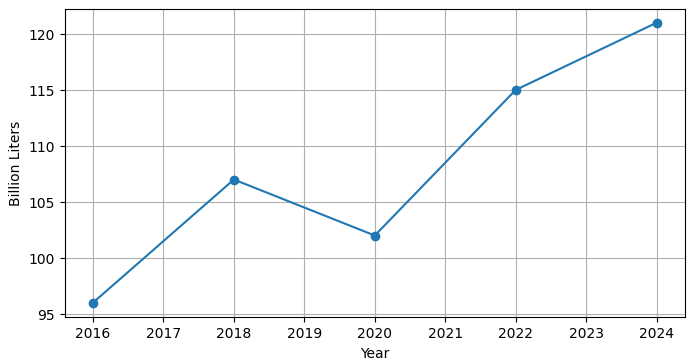
The production of ethanol has increased steadily over the past decade, driven by technological improvements, supportive policies, and rising demand for cleaner transport fuels. In 2024, global ethanol output exceeded 121 billion liters, reflecting renewed momentum in both developed and emerging markets. This growth stems from the adaptability of ethanol feedstocks, from corn and sugarcane to cellulosic biomass, allowing countries to leverage local agricultural strengths.
Ethanol’s renewable nature lies in its biological origins. As crops grow, they absorb atmospheric CO₂, offsetting much of the emissions released during combustion. This closed-loop carbon cycle is far more sustainable than the linear extraction–combustion–emission model of fossil fuels.
Global Ethanol Fuel Production Trend
Environmental Impact: How Ethanol Reduces Carbon Emissions
Ethanol’s environmental benefits stem from cleaner combustion and lower lifecycle emissions. Unlike gasoline, ethanol burns with a higher oxygen content, reducing incomplete combustion byproducts. This leads to noticeable reductions in carbon monoxide, particulate matter, and certain harmful hydrocarbons released into the atmosphere.
Lifecycle assessments show that ethanol delivers substantial greenhouse gas reductions. For example, ethanol derived from corn typically reduces emissions by 20–40% compared to gasoline. In contrast, sugarcane ethanol offers up to 90% lower emissions, thanks to highly efficient crop growth and production methods. Advanced cellulosic ethanol (produced from agricultural residues and non-food biomass) offers even greater environmental advantages, often reaching net-negative emissions when paired with carbon capture systems.
These factors make ethanol a strong candidate for countries seeking immediate and measurable cuts in transportation-related emissions without waiting decades for complete electrification.
Performance Advantages: Ethanol’s High-Octane Efficiency
Ethanol’s naturally high octane rating (averaging around 108 RON) provides superior performance in modern engines. Its high knock resistance allows for optimized combustion, improving efficiency and power output. Flex-fuel vehicles illustrate this advantage, adjusting engine parameters dynamically to maximize performance with ethanol-rich blends.
Blends such as E10, E15, and E85 are now commonly used worldwide, enabling drivers to adopt cleaner fuels without significant engine modifications. This compatibility lowers barriers to adoption, making ethanol an essential part of transitional decarbonization strategies.
The Rise of Advanced Ethanol: Turning Waste into Clean Energy
The next frontier of ethanol innovation is the rapid development of second-generation (2G) and cellulosic bioethanol. Unlike traditional ethanol, which relies on sugar or starch crops, 2G ethanol is produced from non-food materials such as crop residues, forestry byproducts, and municipal waste.
The significance of this shift is profound. By converting agricultural waste streams into high-value fuel, cellulosic ethanol eliminates competition with food supplies, supports circular economic models, and dramatically improves sustainability outcomes. With recent technological breakthroughs in enzymes, pretreatment processes, and integrated biorefinery design, production efficiencies are rising while costs continue to fall.
Countries such as the United States, Brazil, India, and China are heavily investing in these technologies as part of broader commitments to reduce petroleum dependency and accelerate renewable energy adoption.
Policy Momentum & Global Adoption of Ethanol Fuel Blends
Ethanol’s growth is reinforced by aggressive policy frameworks worldwide. Governments recognize ethanol’s value as a drop-in renewable fuel capable of significant emissions reductions at the national scale. The United States maintains widespread adoption of E10, with expanding infrastructure for E15 and E85. Brazil remains the global leader, standardizing E27 blends and promoting widespread use of sugarcane ethanol.
Elsewhere, blending mandates are accelerating rapidly. India’s national target of 20% ethanol blending by 2025 represents one of the world’s most ambitious renewable fuel initiatives, backed by large-scale investment in grain- and sugar-based ethanol production. Similar initiatives across Europe and Asia reflect a broad, global shift toward cleaner fuels.
Overcoming Challenges: The Path to Large-Scale Deployment
While ethanol poses significant advantages, its full potential depends on addressing several practical challenges. These include improving feedstock logistics, reducing production costs for cellulosic pathways, and scaling infrastructure such as pipelines, transport networks, and retail distribution systems. Ongoing research in biotechnology, agricultural optimization, and advanced biorefinery design is already solving many of these barriers and pushing ethanol closer to peak global adoption.
Concluding Thoughts: Ethanol as a Cornerstone of a Low-Carbon Future
Ethanol has transitioned from a supplemental fuel to a critical component of sustainable energy strategies worldwide. With its ability to reduce emissions, enhance engine performance, utilize diverse feedstocks, and integrate into existing transportation infrastructures, ethanol represents a practical and impactful solution for decarbonizing modern mobility.
As advancements in cellulosic technologies and global support policies continue to grow, ethanol’s role in the green economy will only strengthen, making it one of the most promising renewable fuels shaping the future of sustainable energy.
Find a detailed analysis of the ethanol market in the in-demand research report “Ethanol (EtOH): 2026 World Market Outlook and Forecast up to 2035”.